The Adventures of BeetleCam

The modern world of wildlife photography is saturated with thousands of talented photographers producing a huge number of incredible photographs. As a result it is difficult to produce original shots without really pushing the boundaries and striving for new perspectives. Often, this means putting the camera into places that may at first seem impossible.

With this in mind, we were driven to embark upon an ambitious project to photograph African wildlife from a new perspective, one that would involve getting close to potentially dangerous animals and photographing them with a wide-angle lens. Traditionally, this has been achieved using camera traps – stationary cameras triggered when an animal breaks an invisible infra-red beem. The problem with this method is that it requires a great deal of time, patience and luck. We therefore decided to invent something a little more proactive! And so BeetleCam was conceived; a DSLR camera mounted on top of a four-wheel drive remote control buggy.
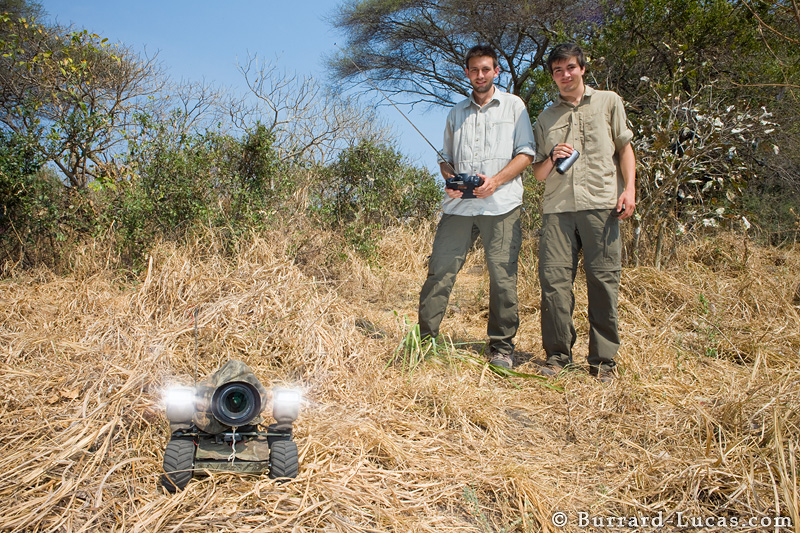

BeetleCam

We booked a trip to Tanzania and set about designing, building and testing BeetleCam. The first step was to get up to speed on the necessary robotics and electronics that would be required to build such a vehicle from scratch. Having conducted some research, we sourced components from around the world. Construction then began in earnest with sawing, soldering, sewing and super gluing taking place around the clock in Will’s garage.

BeetleCam’s primary challenge would be getting over the uneven African terrain with a heavy payload of camera, lens and flashes. We therefore ordered the most powerful motors we could find and large off-road tires. BeetleCam had to be able to operate for long periods without being charged, so we stuffed the vehicle with the biggest batteries we could squeeze in.

We constructed a split ETTL off-camera flash cord that would allow the camera to control the output of two flashes depending on the light conditions (this would be important for filling in the shadows cast by the bright African sun).

After much deliberation, we figured out how to get the camera (our trusty Canon EOS 400D) to interface with the same controller used to drive the buggy. The finishing touches were to camouflage BeetleCam and seal the camera gear and internal mechanisms to protect them from the dusty African environment.

The prototype was finished with a month to spare but proved to be catastrophically unstable! An emergency redesign was undertaken to lower the centre of gravity and, a few days before our departure, BeetleCam was ready for to be let loose in the wild!

Our destinations in Tanzania were Ruaha and Katavi National Parks, both in the South West of the country. They are quiet parks with plenty of wildlife – perfect for trialling BeetleCam.

We thought that Elephants would be an easy subject for BeetleCam’s first outing. We were wrong… we quickly learned that Elephants are wary of unfamiliar objects and due to their highly sensitive hearing, they are almost impossible to sneak up on! Over the course of the trip, we learnt that the best way to photograph an elephant was to position the camera well in front of it and then let the animal approach in its own time. With this technique we enjoyed great success and managed to get some incredible photos of these colossal creatures.

This is the shot we had been dreaming of... a huge bull elephant walking towards BeetleCam in the warm evening light.
A large bull elephants looks at BeetleCam as he walks past.

After obtaining our first photographs of Elephants we were buoyed with optimism and decided to make our second subjects Lions. In hindsight this was a foolish idea; BeetleCam was promptly mauled, and carried off into the bush. A long recovery mission ensued and we were extremely lucky to retrieve an intact memory card from the mangled Canon 400D body. On downloading the images, we were delighted to find that BeetleCam had performed its duty admirably, and we got a great series of images from the encounter.

The photograph taken by BeetleCam just before it was mauled!

Remarkably, although the 400D sustained irreparable damage, the rest of BeetleCam proved very resilient and, with a few pieces of string and bits wood, we were able to patch it up. We replaced the 400D with our only other available camera, a Canon EOS 1D MK III. This increased the stakes massively and obviously meant that lions were off the menu for the rest of the trip! Over the next few days we nervously drove our beloved 1D MK III in front of various unpredictable beasts and prayed it would come back intact!

BeetleCam Repairs

To our surprise it was Africa’s second most dangerous animal that proved to be the most cooperative subject, the African Buffalo. Adult males that are too old to compete for females collect together and form bachelor herds. Despite their reputation for being bad tempered and aggressive, these old brutes were totally unconcerned by the small robot. Some of the buffalo even showed mild curiosity and would amble up slowly to investigate.

Buffalos were totally unconcerned by BeetleCam and posed very cooperatively!
A curious buffalo checks out BeetleCam.

Upon returning to the UK, we were thrilled with the photographs that we had managed to take during our two-weeks spent in the field. We have already started work on BeetleCam Mark II and plan to return to Africa this summer to take more photographs. To receive news about BeetleCam’s future escapades, and to be the first to see the resulting photographs, please subscribe to our free email newsletter (or subscribe to our RSS feed).

For clips of BeetleCam in action checkout our teaser video and for more images taken with BeetleCam, please view the BeetleCam tag.

  • Share
 

60 Comments so far
  1. Lyza said:

    April 19, 2010 at 7:36 am

    Wonderful work!!!

  2. rushh said:

    April 19, 2010 at 7:38 am

    woww…. nice work here.. cool gadget u’ve made… i like large picture @ middle…

  3. Ruben Vicente said:

    April 19, 2010 at 7:55 am

    Genius work! Maybe it’s better to get some sort of metal case around the camera…lion proof =p

    Good luck!

  4. anonymous said:

    April 19, 2010 at 8:15 am

    WOW! I want to do this one day..

  5. Morkel Erasmus said:

    April 19, 2010 at 8:17 am

    Wonderful shots of Africa’s legends…thanks for sharing this, I know Hans Rack of Namibia has a similar type of gizmo with which he operates around the Etosha waterholes.

  6. Shirley said:

    April 19, 2010 at 10:17 am

    With great patience and marvellous enthusiasm

    you have given us all some terrifc animal shots.

    What about some African Sunsets next time you are over there ??

    Thank you for sharing.

  7. Sasa Huzjak said:

    April 19, 2010 at 11:35 am

    Great idea, very cool photos, wish you even more luck on your next BeetleCam adventure!

    PS: Sorry about the 400D, good news about 1D MK III :)

  8. Giles Breton said:

    April 19, 2010 at 11:50 am

    this is fantastic work, and you’re absolutely right about the need for a new fresh perspective on wildlife photography. Have you contacted the guys who set up Spy in the Jungle using trunk cams and tusk cams. Their cameras were tiger proofed as much as you can
    http://www.jdp.co.uk/programmes/Tigers:-Spy-in-the-Jungle

  9. MBUGUA said:

    April 19, 2010 at 12:17 pm

    Guys, this is great.
    I have seen your pics and all can say is that they are very nice. the idea behind it was great.
    i am also a photojournalist based in kenya.
    i am hoping to get a better camera since what i have is a D50 nikon.
    thanks guys.
    post more of that we need to learn more.
    cheers.
    mbugua kibera

  10. Wanda Krack said:

    April 19, 2010 at 12:32 pm

    Wow, what an adventure! Hats off to both of you for your work, enthusiasm, and new perspective! Wishing you luck with your next one!

  11. Emilie said:

    April 19, 2010 at 2:49 pm

    Great invention.

  12. Livia said:

    April 19, 2010 at 3:56 pm

    Amazing guys!
    You are really doing a great job! Keep on the track, you can go even futher on this project! Becareful with the wild!
    Looking forward for the next pics!

  13. Sebastian Kennerknecht said:

    April 19, 2010 at 4:25 pm

    Great stuff as usual. In many of the pictures it looks like you have small DOF considering the wide-angle lens. How where you focusing the camera?
    Thanks,
    Seabass

  14. Eddy Wee said:

    April 19, 2010 at 4:27 pm

    Wow, great work guys!

  15. Anna said:

    April 19, 2010 at 4:42 pm

    What a great adventure you guys had. Awesome pictures great idea.

  16. Jerad Hill said:

    April 19, 2010 at 6:11 pm

    Awesome. I mounted my 5D MKII to my old Traxxas Emax. Maybe what you need to do is rig up a pepper spray to one of the servos that you can fire when it needs to fight back.

  17. Marie Dunphy Harding said:

    April 19, 2010 at 7:27 pm

    I thoroughly enjoyed ‘Will & Matts’ excellent adventure’ story. Can’t wait for BeetleCam2.
    By the way, do bachelor herds only come in buffalo?
    All the best with your future endeavours.

  18. Ravindra Joisa said:

    April 20, 2010 at 8:34 am

    wow.. Too good… great work.. even i’m into photography .. but you guys have tried something extraordinary.. .:)

  19. Vijay Padiyar said:

    April 20, 2010 at 10:08 am

    Whoa!!! Awesome work, folks! Maybe for BeetleCam 2.0, you could try elevating the camera and flashes with a camera rod mounted on the buggy (and a retractable one at that). That would help you take pictures from a more conventional height (similar to a sitting person), which would look even more natural.

    No one would be able to figure out that the pics were taken remotely! Also, you would be able to eliminate the twigs from the pics by raising the camera above them. And by making it retractable, you would be able to lower the camera when not taking pictures.

  20. Vijay Padiyar said:

    April 20, 2010 at 10:14 am

    Or perhaps work on a CopterCam for next time! A camera and flashes mounted on a radio-controlled helicopter. That would allow you to take close snaps while still keeping your camera out of range of the animal!

  21. Jacob Cherian said:

    April 20, 2010 at 10:27 am

    love the pics! i can’t wait for the Flying Chopper SLR next.. :)

  22. Chiranjib Sur said:

    April 20, 2010 at 12:40 pm

    It was so much fun reading your experience. Some pictures of the invention (Beetlecam with your 1D MIII) will be of more fun – yes the equipment itself !

    You two really rocks ! Congratulations and all the best for your next trip.

  23. Brian Pohl said:

    April 20, 2010 at 1:30 pm

    Like the pepper spray idea, but simpler yet. Soak the outer cover/cloth with hot pepper spice (e.g. cayenne?) to make it less attractive to sniffing / chewing / picking up by mouth. Not sure how you deal with a lion paw knocking it on its side … then it would be more like a turtle-cam.

  24. Will said:

    April 20, 2010 at 2:52 pm

    Thanks for all the comments guys. We can’t wait to get out to Africa with BeetleCam Mark II!

    Also, thanks for all the suggestions. It would not be very responsible of us to start pepper spraying or electrocuting lions so I think we might just go with a stronger carapace next time!

    - Will

  25. Maud Guye-VUillème said:

    April 20, 2010 at 3:29 pm

    Genius ! Love it :)

  26. Charles said:

    April 20, 2010 at 3:55 pm

    How come nobody thought of this 50 years ago? Can you encase the camera in a steel frame or mesh? Or add something repulsive like a sponge soaked ammonia? Or glue Barbies all over it, so it’s like a Malibu beach buggy. Or a space man and a sign that says “We come in peace” so the animals can read it.

  27. Ant West said:

    April 20, 2010 at 4:06 pm

    Bravo, Gentlemen! What an awesome unique experience this must have been! Hats off to you for this – you surely deserve some kind of accolade for your intepid spirit of adventure and thinking out of the box! Woohoo!
    I love the low andled shots, especially of the elephants. Curious to know how you aim at the subjects from a distance, or does the wide angle take care of the panorama?
    Consider creating a reinforced fibre-glass “pod” which resembles a rock for protecting the camera equipment and go back to the lions… :)

  28. enscript said:

    April 20, 2010 at 7:07 pm

    Congratulations ! What an achievement ! Really looking forward to pictures/videos & updates on next trip.

  29. Mike said:

    April 20, 2010 at 7:20 pm

    These are great shots. Wonderful creativity and pushing the boundaries of what you can do with technology.

  30. Michael Longstaff said:

    April 20, 2010 at 7:36 pm

    You guys are geniuses. You have combined two of my favourite things and are getting awesome images as a result. I wish all the success in the world for the Beetlecam project!

  31. Sean said:

    April 20, 2010 at 10:27 pm

    Great design! Couple of questions raise from a photographer’s point of view, how do your camera meter when it’s totally camouflaged? The two elephant pictures on this page are all in AV mode at f/7.1, iso 320. The buffalo pictures stuck on the same setting. It seems when the BeetleCam goes out there, it’s out there. No camera controls. Hopefully you guys could find an easier way to control camera and composition.

    Cheers!

  32. Indy said:

    April 20, 2010 at 11:48 pm

    You might consider using an EyeFi SD card card that will upload pictures over wifi so pictures can survive device catastrophe. You can purchase a pocket sized wifi network basestation and the EyeFi can talk directly to an iPhone or an Android phone, so two battery powered widgets in your pocket are all that is required. However, I know the first gen EyeFi cards had significant saving lag in pro cameras, so it’s worth investigating if that problem has been fixed in their later gen cards.

  33. Joe Zuniga said:

    April 21, 2010 at 6:43 am

    I think the most non-destructive way to fend off ‘would be maulers’ would be to tie in a couple of airhorns to the BeetleCam.

    The cost of finding a way to shoo away kitties with attitudes I think outweighs losing another camera, or worse, the memory card :( .

    Anyway, the photos were FANTASTIC!! Keep them coming.

  34. Kevin said:

    April 21, 2010 at 8:22 am

    I may be biased, but I think you should give the Olympus E-3 a go. It’s extremely rugged, being dust and moisture proof, and several of them can be had for the price of one 1D. Not to mention all their high-grade lenses are dust and moisture proof as well.

  35. Dr, Nicolas Rao said:

    April 21, 2010 at 11:59 am

    This is really exciting and amazing.
    Kudos on a great job and may all your efforts be blessed with great photos.
    I got the link from my photo Society’s yahoo group.
    It is very inspiring for us to hear of such things!
    You could perhaps check out our Photo Society at
    Photomadras.org
    Nicolas Rao

  36. Markus said:

    April 21, 2010 at 1:51 pm

    What a brilliant project !
    But yes, that would be my question as well. how did you manage the camera controls? And, did you use an external meter? OR did you just shoot with an appropriate setting suiting the situation?

    A steel cage around the cam would prevent it from being damaged. I am sure you could position the flashes so you would not deal with shadows (that is the least problem here I suppose), but it would not prevent the camera from being carried away… ;)

    Markus

  37. Val said:

    April 21, 2010 at 5:49 pm

    If you’re gonna jump on the cage and so on, you might think of a way to flip it back over. I would think they’re trying to avoid all those things, and save weight/battery life.

    Most of these animals would probably leave the camera alone, as long as it leaves them alone, kind of thing.

  38. Igor said:

    April 21, 2010 at 8:17 pm

    Next time use skunk odour to protect BeetleCam from lions)

  39. Joe said:

    April 22, 2010 at 6:21 am

    the Discovery Channel (I think) made one of these a few years back and got lions close up, ran with them, etc. you could do what they did, and put a rounded hard case around the whole thing with a hard flat bottom. It could still get flipped, but at least the camera would not be mauled.

  40. Clive said:

    April 22, 2010 at 4:30 pm

    awesome stuff!

  41. Gerry (Photo-Africa) said:

    April 22, 2010 at 9:06 pm

    Absolutely great idea and execution! Well done guys!

  42. Yalonda said:

    April 23, 2010 at 12:34 am

    These are some amazing shots! And it’s incredible how you created the BeetleCam!
    I just started learning photography about a year ago and I’ve completely fallen in love with it! I hope to someday be able to do something as great as you have here!

  43. FTNer said:

    April 23, 2010 at 3:17 am

    that is one freaking cool gadjet!! awesome idea.
    looking foward to see more photos..

    maybe it should have a protective cover for the camera..

  44. resmi said:

    April 23, 2010 at 4:13 am

    nice information,man.I also wanna go like to for animals.

  45. Elaine said:

    April 23, 2010 at 12:47 pm

    Hi, you could use a trick that livestock farmers and rangers use worldwide and which would be a cheap and easy answer to any animal making contact with the bot- a simple chicken wire grill hooked to the battery to givevery small deterent electrical shocks. It wont deter the lions from coming near like the sprey would and is light and cheap.

    As for the photographs, amazing shots! Well done.

  46. Greg Jordan said:

    April 23, 2010 at 4:04 pm

    So cool! Congrats on your piece in Wired.

  47. James said:

    April 24, 2010 at 6:13 pm

    Nice pictures! and a great idea I may post this on my blog.

  48. Richard Harris said:

    April 26, 2010 at 8:35 am

    This is great. I was thinking of changing my EOS400D for a 50D but now I view it with renewed respect. If it’s good enough for you and the lions…

  49. sanjay said:

    April 26, 2010 at 5:00 pm

    ya its realy awsome wana take some pic lik this

  50. SINA said:

    April 28, 2010 at 5:30 am

    Hey ;)
    goood pictures!
    but do you think about when an elephant fall in love with BeetleCam and want to touch it!

  51. mehdi said:

    April 28, 2010 at 9:11 am

    very niceee
    I post this on my site.
    Thank you

  52. TCG said:

    April 28, 2010 at 1:33 pm

    I’ve been showing this to all my science and photo friends and one typically well rounded guy sent me this back instantly:

    http://upload.wikimedia.org/wikipedia/commons/d/d7/Pigeon_photographers_and_aerial_photographs.jpg

    I am NOT advocating strapping a MK III to a lion, because I want you two to keep making awesome images!

  53. Will said:

    April 28, 2010 at 2:16 pm

    Great find TCG! I am looking for pigeons on ebay as I type :)

  54. dinane said:

    April 29, 2010 at 8:10 pm

    I am totally impressed by what you embarked on and the results! The lioness pictures on National Geographic’s website and the one here are simply amazing. I am sorry you had to mourn the passing of your camera – I have the same model and would be sad to see it so mauled – but glad that your backup plan worked flawlessly. Amazing. And thank you for sharing it with the world.

  55. Anne said:

    May 2, 2010 at 10:16 am

    Great idea resulting in some awesome shots! I found your website after seeing a full page spread of your photos in an Australian newspaper.
    Looking forward to seeing more of your work.

  56. Fort Myers Photographer said:

    May 2, 2010 at 3:35 pm

    Great photos and I love the prospective!

  57. aviram said:

    May 28, 2010 at 6:36 pm

    just amazing !!!

  58. Warren Williams said:

    June 20, 2010 at 2:23 am

    Stunning photos, and great work on the model. Well worth it :)

  59. pete krohn said:

    June 29, 2010 at 1:31 pm

    plenty of inexpensive 12MEGPIXEL surplus cams available for ‘testing’ purposes. (Nikon coolpix, pentax optio, etc ) extremely lightweight too. req some hacking but fully disposable compared to these ‘precious cameras’ you seem to like to commit to their demise. plenty of ‘off the shelf’ remote xmit/rcvr options for control. robotware is a growing hobby, all kinds of help on the net for you!

    im thinking ‘noise, lots of it, shrill, nasty and controllable’ when it come to defenses in wild animal arenas.

    even a microphone and emitter to talk to the animals? soothe them, make them your friend, LOL

    most wildlife park rules forbid any contact or ‘contamination’ with the animals, so noxious chemicals are taboo!

  60. Susanne Agaiby said:

    July 9, 2010 at 4:57 pm

    Amazing Work. I love your photos!! :)

60 Responses to “The Adventures of BeetleCam”


RSS Feed | BL Blog is proudly powered by WordPress.org
Copyright © 2010 Burrard-Lucas Wildlife Photography. All rights reserved.
Turn lights off